
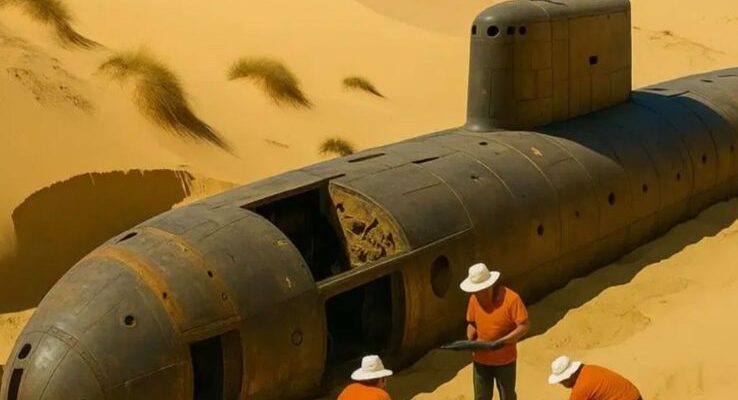
No one could have imagined such a thing.
In a place where there should only be sand and heat, researchers stumbled upon an object that defied all logic.
It all began after a powerful sandstorm swept across the region in February 2024. During a routine satellite survey, Saudi analysts noticed a thin, vertical shadow among the dunes.
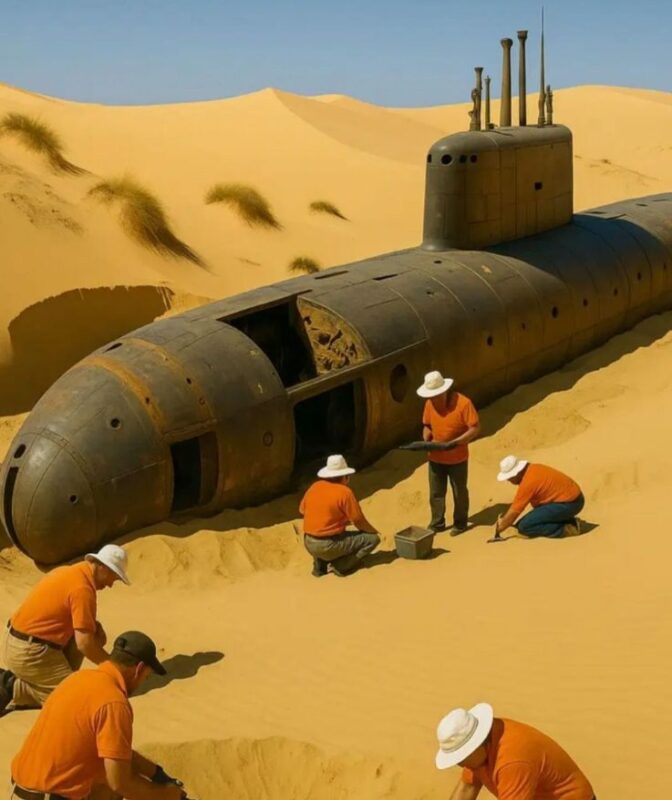
At first, they believed it to be the remains of a downed aircraft. But when an artificial intelligence system analyzed the shape and proportions, the identification it returned sent chills down everyone’s spine — a submarine periscope.
The discovery went global within hours. A special emergency task force was assembled: scientists, engineers, military experts, archaeologists, biologists, and nuclear safety authorities.
Within just three days, an international expedition was already crossing the desert toward the coordinates.
When they arrived, disbelief washed over them. Rising from the sand was a long, corroded metal hull — its surface flaking and rusted, but unmistakably vast.
A complete submarine, stranded under the relentless desert sun, thousands of miles from the nearest ocean.
But the closer they got, the stranger things became.
Navigation equipment failed instantly. GPS systems insisted the team was somewhere in the Indian Ocean.
Compasses began to spin wildly. Drone feeds were cut off. Radiation meters flickered with erratic but concerning spikes. The local desert guide refused to go any further.
Then came the most unsettling moment. Dozens of wild camels appeared on the horizon. With no herder and no sound, they walked in formation and stood in a perfect circle around the submarine — silent and motionless.
Once the hatch was forced open, the air that escaped was stagnant and suffocating, like a tomb sealed for decades.
Inside, the scene was frozen in time.
The crew — more than thirty men — were found exactly where they had been during their final moments. Some were still seated at control panels.
Others had collapsed in narrow corridors. Some were near the exit, as if they had tried to escape in their last seconds.
Cabins contained personal belongings: letters, family photographs, books written in various languages. Everything suggested the vessel had been active around the mid-20th century.
But the hull number and internal mechanisms did not match any submarine ever recorded in naval archives. Then the team found the documents.
Most were decayed, but fragments remained intact enough to read. They referred to a secret monitoring operation on experimental nuclear sites in the Persian Gulf. The listed year was 1968.
No country was named. The crew’s identities were coded. Only one chilling line was completely clear:
“Contact confirmed. Device activated. Time window open: 36 seconds.”
No researcher could say what it meant.
The submarine was sealed and transported away. The deceased crew members were buried with full military honors. The camels vanished without a trace.
But one unanswered question remains